




Nissan Frontier: Wheels and tires
Tire pressure
Tire Pressure Monitoring System (TPMS)
WARNING
Radio frequency signals emitted by the TPMS in your Nissan Frontier may interfere with certain medical devices.
Drivers using medical equipment such as pacemakers should consult the device manufacturer to verify compatibility before operating the Nissan Frontier.
This Nissan Frontier is equipped with a Tire Pressure Monitoring System (TPMS) designed to continuously monitor the air pressure in all tires except the spare.
If the tire pressure in one or more tires drops significantly, the low tire pressure warning light will illuminate and a "Tire Pressure Low - Add Air" message will appear in the vehicle information display of your Nissan Frontier.
The TPMS activates when the Nissan Frontier is driven at speeds above 16 mph (25 km/h). However, it may not immediately detect rapid air loss, such as a sudden tire puncture or blowout.
Tire inflation pressure
Maintaining proper tire pressure in your Nissan Frontier is essential for safety, fuel efficiency, and tire longevity. Always check tire pressures regularly, including the spare tire, and especially before long-distance travel.
The recommended tire pressure values for your Nissan Frontier can be found on the F.M.V.S.S./C.M.V.S.S. certification label or the Tire and Loading Information label located on the driver-side center pillar. These values are listed under "Cold Tire Pressure."
Tire pressure should be monitored frequently because:
- Tires naturally lose air over time, even under normal driving conditions.
- Air pressure may decrease suddenly if the Nissan Frontier drives over potholes, debris, or strikes a curb.
The tire pressure of your Nissan Frontier should always be checked when the tires are cold. Tires are considered cold after the vehicle has been parked for at least 3 hours or driven less than 1 mile (1.6 km) at moderate speed.
The TPMS with Easy-Fill Tire Alert in your Nissan Frontier provides both visual and audible feedback to assist in achieving the correct cold tire pressure during inflation.
Incorrect tire pressure, including under-inflation or over-inflation, can negatively impact tire lifespan, handling stability, and overall safety of your Nissan Frontier.
WARNING
- Improper tire pressure in your Nissan Frontier may cause sudden tire failure, potentially leading to a serious accident.
- The Gross Vehicle Weight Rating (GVWR) for your Nissan Frontier is listed
on the certification label, while load capacity is specified on the Tire and
Loading Information label.
Do not exceed the recommended load limits. Overloading your Nissan Frontier can result in reduced tire durability, compromised handling, and increased risk of tire failure.
Exceeding load capacity may also cause damage to suspension, braking, and other critical vehicle systems.
- Before long trips or when carrying heavy loads in your Nissan Frontier, always verify tire pressure using an accurate tire pressure gauge.
- For more detailed tire safety guidelines, refer to the "Important Tire Safety Information" section (US) or "Tire Safety Information" (Canada) in the Warranty Information Booklet.
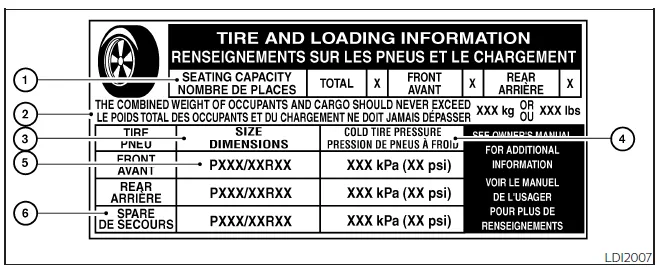
Tire and Loading Information label
- Seating capacity: Indicates the maximum number of passengers that can safely occupy your Nissan Frontier at one time.
- Vehicle load limit: Specifies the maximum allowable combined weight of occupants and cargo for your Nissan Frontier.
- Original tire size: Displays the factory-installed tire dimensions designed to deliver optimal performance and safety for the Nissan Frontier.
- Cold tire pressure: This is the recommended inflation level for your Nissan Frontier tires when they are cold. Tires are considered cold after the vehicle has been parked for at least 3 hours or driven less than 1 mile (1.6 km). Maintaining this pressure ensures the best balance between tire wear, ride comfort, fuel efficiency, and handling performance up to the vehicle’s GVWR.
- Tire size: Confirms the correct tire specifications suitable for your Nissan Frontier.
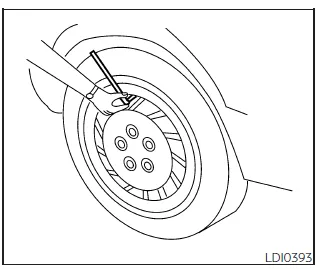
Checking tire pressure
1. Remove the valve stem cap from the tire on your Nissan Frontier.
2. Firmly press the tire pressure gauge onto the valve stem. Avoid pressing too hard or at an angle, as this may cause air leakage.
If you hear a hissing sound while measuring, reposition the gauge to obtain an accurate reading without losing air.
3. Remove the gauge from the valve stem.
4. Read the pressure value displayed on the gauge and compare it with the recommended specifications listed on the F.M.V.S.S./C.M.V.S.S. label or the Tire and Loading Information label of your Nissan Frontier.
5. Inflate the tire as necessary. If the tire is overinflated, briefly press the valve core using the gauge tip to release excess air. Always recheck the pressure after adjustment to ensure accuracy.
6. Reinstall the valve stem cap securely to protect the valve from dirt and moisture.
7. Repeat this process for all tires on your Nissan Frontier, including the spare, to ensure consistent performance and safety.
Size/Cold Tire Inflation Pressure:
Front and Rear Original Tire
- P265/70R16 or 265/65R17 or 265/70R17
- 35 psi
- 240 kPa
Original Tire/Spare Tire Size
- P265/70R16
- Full Size
- 265/65R17
- P265/70R16
- 265/70R17
- Full Size
- Tire size (example: P215/65R15 95H)
- TIN (Tire Identification Number) for a new tire (example: DOT XX XX XXX XXXX)
- TIN (Tire Identification Number) for a new tire (example: DOT XXX XXXXXX XXXX)
- Tire ply composition and material
- Maximum permissible inflation pressure
- Maximum load rating
- Term of "tubeless" or "tube type"
- The word "radial"
- Manufacturer or brand name
- When replacing tires on your Nissan Frontier, always ensure that all four tires are of the same category (Summer, All-Season, or Snow) and share identical construction characteristics. A NISSAN dealer can assist with selecting the correct tire specifications including size, speed rating, and availability for your Nissan Frontier.
- Replacement tires installed on the Nissan Frontier may have a lower speed rating than the original factory tires. Always respect the tire’s maximum speed rating and never exceed it, as doing so may compromise safety.
- Installing tires that differ from the original NISSAN specifications may interfere with the proper functioning of the Tire Pressure Monitoring System (TPMS) in your Nissan Frontier.
- Always use tires of the same type, size, brand, construction, and tread pattern on all four wheels of your Nissan Frontier. Differences in tire circumference between front and rear axles can negatively affect the Vehicle Dynamic Control (VDC) system, potentially leading to unsafe driving conditions, accelerated tire wear, or damage to drivetrain components such as the transmission and differential.
- For more detailed safety guidelines regarding tire usage on the Nissan Frontier, refer to the "Important Tire Safety Information" (US) or "Tire Safety Information" (Canada) sections in the Warranty Information Booklet.
- After rotating the tires on your Nissan Frontier, always check and adjust tire pressure to the recommended levels.
- Retighten the wheel nuts after driving approximately 600 miles (1,000 km), especially after a tire change or repair.
- The spare tire should not be included in the standard tire rotation process for your Nissan Frontier.
- Refer to the "Important Tire Safety Information" (US) or "Tire Safety Information" (Canada) sections in the Warranty Information Booklet for additional guidance.
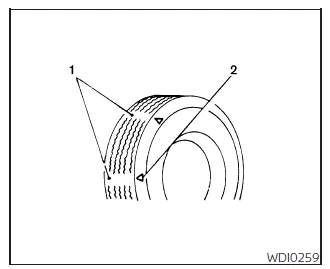
- Wear indicator
- Location mark
- Tires on your Nissan Frontier should be inspected regularly for signs of wear, cracking, bulging, embedded objects, or structural damage. If any of these conditions are present, replace the affected tire immediately.
- Factory-installed tires on the Nissan Frontier include built-in tread wear indicators. When these indicators become visible, the tire has reached its wear limit and must be replaced.
- Tires deteriorate over time due to age, environmental exposure, and usage. Tires older than 6 years, including the spare tire, should be inspected by a qualified technician even if they appear undamaged. Replace them if necessary to avoid sudden failure.
- Improper servicing or repair of the spare tire may lead to serious injury. For safe handling and repair, it is recommended to consult a NISSAN dealer.
- Always refer to official tire safety documentation for your Nissan Frontier for additional recommendations and maintenance practices.
- Using tires that differ from those recommended for your Nissan Frontier, or mixing different brands, constructions (bias, bias-belted, or radial), or tread patterns, can negatively impact ride quality, braking efficiency, handling stability, and the performance of systems such as Vehicle Dynamic Control (VDC). It may also affect ground clearance, tire-to-body clearance, speedometer accuracy, headlight alignment, and bumper height, potentially leading to accidents and serious injury.
- If your Nissan Frontier was originally equipped with four identical tires and only two need replacement, always install the new tires on the rear axle. Installing new tires on the front axle may reduce vehicle stability and increase the risk of loss of control under certain driving conditions.
- If wheels are replaced for any reason, always use wheels with the same offset and specifications as the original Nissan Frontier equipment to maintain proper alignment and safe operation.
- When a wheel without a Tire Pressure Monitoring System (TPMS) sensor is installed on your Nissan Frontier, such as a spare wheel, the TPMS will be disabled. In this case, the low tire pressure warning light will flash for approximately one minute and then remain illuminated. Have the TPMS system inspected and reset as soon as possible by a qualified technician or NISSAN dealer.
- Installing tires that do not meet the original specifications for your Nissan Frontier may interfere with proper TPMS operation and overall vehicle performance.
- Handle TPMS sensors with care during tire service on your Nissan Frontier. Improper handling may damage the sensor and lead to inaccurate pressure readings.
- When replacing TPMS sensors, ID registration may be required for proper system functionality. It is recommended that this procedure be carried out by a NISSAN dealer.
- Only use valve stem caps specified for your Nissan Frontier. Incorrect caps may seize or cause sealing issues.
- Ensure that valve stem caps are properly installed to prevent dirt or debris from entering the valve, which could lead to air leaks or system malfunction.
- Never install wheels or tires that are damaged, bent, or deformed—even if previously repaired. Such components may have hidden structural weaknesses and could fail unexpectedly while driving your Nissan Frontier.
- The use of retreaded tires is not recommended for the Nissan Frontier, as they may not provide the same level of safety, durability, or performance.
- For additional tire safety information relevant to your Nissan Frontier, refer to the "Important Tire Safety Information" (US) or "Tire Safety Information" (Canada) sections in the Warranty Information Booklet.
Maintaining correct tire pressure in your Nissan Frontier not only improves safety but also enhances fuel efficiency, tire longevity, and overall driving stability in various road conditions.
Tire labeling
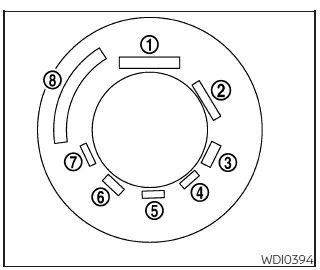
Example
Basic information
For every Nissan Frontier, federal regulations require that tire manufacturers imprint standardized markings directly onto the tire sidewall.
These markings provide essential information about the tire’s construction, performance capabilities, and identification details. They also include the Tire Identification Number (TIN), which plays a critical role in safety tracking and recall situations for your Nissan Frontier.
Understanding tire labeling on your Nissan Frontier helps ensure correct tire selection, safe operation, and compliance with manufacturer specifications.
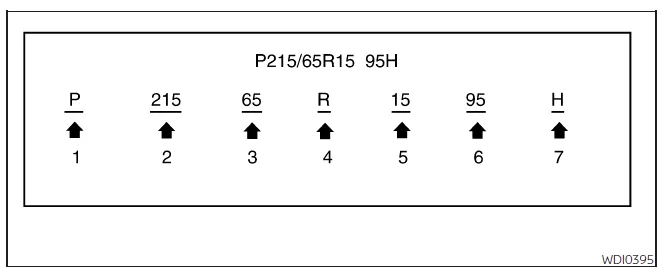
Example
1. P: The letter "P" indicates that the tire is designed for passenger vehicles such as the Nissan Frontier (note: some tires may not include this marking).
2. Three-digit number (215): This value represents the tire width in millimeters, measured from sidewall to sidewall.
3. Two-digit number (65): Known as the aspect ratio, this number defines the height of the tire sidewall as a percentage of its width.
4. R: The letter "R" signifies that the tire uses radial construction, which is standard for modern Nissan Frontier tires.
5. Two-digit number (15): This number indicates the diameter of the wheel (rim) in inches that the tire is designed to fit.
6. Two- or three-digit number (95): This is the load index, specifying the maximum load capacity each tire can safely support.
7. H: This letter represents the tire speed rating. Always ensure that your Nissan Frontier is operated within the limits defined by this rating.
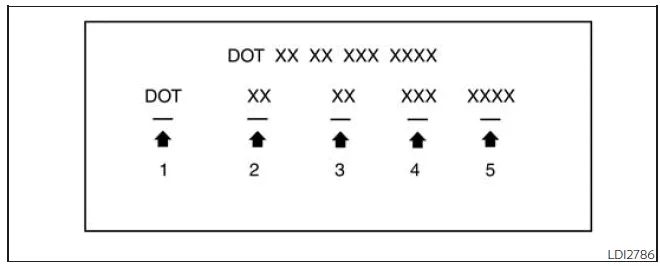
Example (Type A) (if so equipped)
1. DOT: Indicates compliance with standards set by the Department of Transportation. The marking may appear in different positions around the TIN.
2. Two-digit code: Identifies the manufacturer of the tire.
3. Two-digit code: Indicates the tire size classification.
4. Three-digit code: Optional code identifying tire type or internal specifications.
5. The final four digits show the week and year of manufacture.
For example, “3103” indicates the tire was produced in the 31st week of 2003. If this code is not visible, check the opposite sidewall of the tire on your Nissan Frontier.
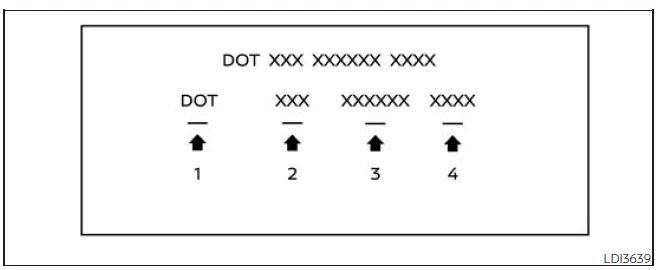
Example (Type B) (if so equipped)
1. DOT: Department of Transportation compliance marking.
2. Three-digit code: Manufacturer identification.
3. Six-digit code: Descriptive code indicating tire design and characteristics.
4. Final four digits: Week and year of manufacture for the tire installed on your Nissan Frontier.
As with Type A, if the manufacturing date is not visible, inspect the opposite side of the tire.
This marking identifies the number of internal layers (plies) used in the tire and the materials from which they are constructed, such as steel, polyester, or nylon, ensuring durability and strength for your Nissan Frontier.
This value indicates the highest allowable air pressure for the tire. Never exceed this limit when inflating tires on your Nissan Frontier.
This number specifies the maximum load that the tire can safely carry, expressed in kilograms and pounds. Always replace tires on your Nissan Frontier with ones that meet or exceed this rating.
This designation indicates whether the tire is designed to be used without an inner tube (tubeless) or requires one (tube type).
If present, this confirms that the tire uses radial construction, which is standard for Nissan Frontier vehicles.
The tire brand or manufacturer name is clearly molded into the sidewall.
Other Tire-related Terminology
In addition to standard tire markings, your Nissan Frontier tires may include the term "Intended Outboard Sidewall." This refers to the side of the tire that must face outward when mounted.
This sidewall may feature white lettering, branding, or distinctive markings that differ from the inner side. On asymmetrical tires used on the Nissan Frontier, correct orientation is critical for optimal performance, handling, and safety.
Types of tires
Basic information
WARNING
All season tires
NISSAN equips certain Nissan Frontier models with All-Season tires to provide balanced performance across a wide range of driving conditions, including dry, wet, and light snowy roads.
All-Season tires are typically marked with “ALL SEASON” and/or “M&S” (Mud and Snow) on the sidewall, indicating their versatility.
While suitable for year-round use, All-Season tires on the Nissan Frontier may not deliver the same level of traction as dedicated winter tires in severe snow or icy conditions.
Summer tires
Some Nissan Frontier configurations are fitted with summer tires, which are optimized for maximum performance on dry and wet pavement during warmer temperatures.
However, summer tires experience a significant reduction in grip when exposed to cold temperatures, snow, or ice. They do not carry the “M&S” marking on the sidewall.
If you intend to drive your Nissan Frontier in winter conditions, it is strongly recommended to switch to Snow tires or All-Season tires on all four wheels.
Snow tires
For enhanced winter performance, snow tires can be installed on your Nissan Frontier. These tires are specifically engineered to provide superior traction on snow-covered and icy roads.
When selecting snow tires, ensure they match the original tire size and load rating specified for the Nissan Frontier. Using incorrect sizes may negatively impact handling, braking performance, and overall vehicle safety.
Snow tires often have lower speed ratings compared to factory-installed tires. Always adhere to the maximum speed rating indicated on the tire sidewall.
For optimal performance and safety, all four snow tires on your Nissan Frontier must be identical in size, brand, construction, and tread pattern.
In regions with extreme winter conditions, studded tires may be considered to improve traction. However, their use is subject to local regulations, and some regions restrict or prohibit them entirely.
Additionally, studded snow tires may provide reduced performance on dry or wet roads compared to non-studded winter tires, so careful driving is essential when using them on your Nissan Frontier.
Choosing the correct tire type for your Nissan Frontier based on climate and driving conditions plays a critical role in maintaining safety, efficiency, and overall vehicle performance.
Tire chains
WARNING
When using tire chains on your Nissan Frontier, it is critical to ensure that there is adequate clearance between the tires and nearby suspension or body components. Incorrect chain size or improper installation may cause serious damage to braking systems, suspension parts, or body panels, potentially resulting in an accident with severe injury or fatal consequences.
Before installing tire chains on your Nissan Frontier, always verify local regulations, as the use of chains may be restricted or prohibited in certain regions.
When selecting tire chains, ensure they are specifically sized for the tires installed on your Nissan Frontier and follow the manufacturer’s installation instructions carefully. Only SAE Class "S" chains should be used, as they are designed for vehicles with limited clearance between the tire and surrounding components.
Nissan Frontier models compatible with Class "S" chains are engineered to maintain minimum safe clearances based on factory tire specifications. Using other types of chains may result in vehicle damage or compromised safety.
If recommended by the chain manufacturer, use chain tensioners to ensure a secure and even fit. Any loose chain ends must be properly fastened or removed to prevent them from striking the vehicle body, which could damage fenders, wheel wells, or underbody components.
For best performance and safety while using tire chains on your Nissan Frontier, avoid carrying heavy loads and always operate the vehicle at reduced speeds. Driving aggressively or at higher speeds with chains installed may negatively affect handling, traction, and overall vehicle stability.
Install tire chains only on the rear wheels of your Nissan Frontier. Never install them on the front wheels, as this may interfere with steering and suspension operation.
Avoid using tire chains on dry or clear pavement. Doing so may cause excessive stress on drivetrain components, leading to premature wear or mechanical damage.
When driving your Nissan Frontier on clear, paved roads, operate the vehicle in 2WD mode whenever possible to reduce strain on the drivetrain and improve overall efficiency.
Proper use of tire chains on your Nissan Frontier significantly enhances traction in winter conditions, but must always be combined with cautious driving and awareness of road conditions for maximum safety.
Changing wheels and tires
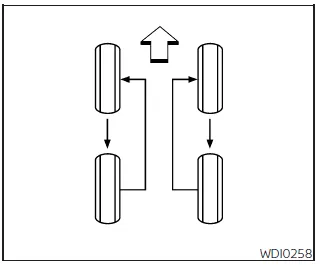
Tire rotation
To maintain optimal performance, even tire wear, and extended tire life on your Nissan Frontier, regular tire rotation is essential. NISSAN recommends rotating the tires approximately every 7,500 miles (12,000 km).
Consistent tire rotation on your Nissan Frontier helps distribute wear evenly across all tires, improving ride comfort, traction, and overall driving stability.
As soon as possible, tighten the wheel nuts to the specified torque with a torque wrench.
Wheel nut tightening torque: 98 ft-lb (133 N·m)
The wheel nuts must be kept tightened to specifications at all times.
It is strongly recommended that wheel nuts on your Nissan Frontier are checked and tightened to specification at every tire rotation interval to ensure safety.
WARNING
Tire wear and damage
WARNING
Replacing wheels and tires
When replacing tires on your Nissan Frontier, always select tires that match the original specifications in size, tread design, load rating, and speed rating. This ensures proper handling, braking, and system compatibility.
WARNING
Proper maintenance, inspection, and timely replacement of wheels and tires on your Nissan Frontier are critical for ensuring long-term reliability, driving safety, and optimal vehicle performance in all conditions.
Using wheels with an incorrect offset on your Nissan Frontier may lead to uneven and premature tire wear, negatively impact handling stability, interfere with proper Vehicle Dynamic Control (VDC) operation, and potentially cause contact with brake components. Such interference can reduce braking performance and accelerate brake pad wear, compromising overall safety.
Four-wheel drive models

CAUTION
For four-wheel drive Nissan Frontier models, always install tires that are identical in type, size, brand, construction (bias, bias-belted, or radial), and tread pattern on all four wheels. Failure to maintain uniformity can create differences in tire circumference, leading to excessive wear and potential damage to the transmission, transfer case, and differential components.
If uneven or excessive tire wear is observed on your Nissan Frontier, it is strongly recommended to replace all four tires simultaneously with matching specifications. Additionally, tire pressure and wheel alignment should be checked and adjusted as necessary. For best results, consult a NISSAN dealer for professional inspection and service.
Wheel balance
Proper wheel balance is essential for maintaining smooth handling, ride comfort, and tire longevity in your Nissan Frontier. Over time, even with normal driving, wheels can become unbalanced.
Routine balancing ensures that weight is evenly distributed around the wheel, minimizing vibrations and reducing stress on suspension components.
Wheel balance service should be performed with the wheels off the vehicle.
Balancing wheels while mounted on the vehicle (spin balancing) may result in mechanical damage and is not recommended for the Nissan Frontier.
- For additional tire-related guidance, refer to the official tire safety documentation provided for your Nissan Frontier.
Care of wheels
- Clean the wheels of your Nissan Frontier regularly during vehicle washing to maintain appearance and prevent buildup of brake dust and contaminants.
- Wash the inner surfaces of the wheels when performing tire changes or cleaning the underbody of the vehicle.
- Avoid using abrasive or harsh chemical cleaners that may damage the finish of the wheels on your Nissan Frontier.
- Inspect wheel rims frequently for dents, corrosion, or other damage that could compromise tire sealing or cause gradual air loss.
- Applying a protective wax coating to the wheels is recommended, especially in regions where road salt is used, to protect against corrosion and extend wheel life.
Regular inspection and proper care of wheels and tires on your Nissan Frontier will help ensure safe driving performance, extended component lifespan, and optimal handling under all driving conditions.
Spare tire (FULL SIZE TEMPORARY USE ONLY spare tire)
When a wheel without a Tire Pressure Monitoring System (TPMS) sensor is installed on your Nissan Frontier, such as the spare tire, the TPMS will not operate and will not provide pressure warnings.
Depending on the configuration, your Nissan Frontier may be equipped with a full-size spare tire that differs in size or brand from the original factory-installed tires.
This FULL SIZE TEMPORARY USE ONLY spare tire is designed strictly for short-term emergency situations and should be replaced with a matching standard tire for your Nissan Frontier as soon as possible.
Follow the precautions below when using the FULL SIZE TEMPORARY USE ONLY spare tire on your Nissan Frontier. Failure to follow these recommendations may result in vehicle damage or increased risk of an accident:
WARNING
To reduce the risk of a collision that could lead to serious injury or death:
- The FULL SIZE TEMPORARY USE ONLY spare tire on your Nissan Frontier is intended solely for emergency use. Replace it with a proper tire at the earliest opportunity to prevent possible damage to tires or drivetrain components.
- Drive cautiously when the spare tire is installed on your Nissan Frontier. Avoid sudden steering inputs, sharp cornering, and aggressive braking, especially on wet, icy, or snow-covered roads where vehicle stability may be reduced.
- When the FULL SIZE TEMPORARY USE ONLY spare tire is in use, the Vehicle Dynamic Control (VDC) system in your Nissan Frontier will generally continue to operate normally.
- However, certain advanced safety and assistance systems may not function
correctly when the spare tire is installed, including:
- Tire Pressure Monitoring System (TPMS)
- Automatic Emergency Braking (AEB) with Pedestrian Protection
- Regularly check the air pressure of the FULL SIZE TEMPORARY USE ONLY spare tire. Always maintain the pressure specified on the Tire and Loading Information label for your Nissan Frontier.
- Do not exceed a speed of 50 mph (80 km/h) when driving your Nissan Frontier with the spare tire installed.
- When driving on snow- or ice-covered roads, install the FULL SIZE TEMPORARY USE ONLY spare tire on the front axle and use the original tires on the rear axle. Tire chains should only be installed on the drive wheels of your Nissan Frontier.
- Never use the FULL SIZE TEMPORARY USE ONLY spare tire from your Nissan Frontier on another vehicle.
- Do not install more than one temporary spare tire on your Nissan Frontier at the same time.
- Avoid towing a trailer while operating your Nissan Frontier with the temporary spare tire installed, as this may compromise stability and drivetrain performance.
CAUTION
- Do not use tire chains with the FULL SIZE TEMPORARY USE ONLY spare tire on your Nissan Frontier. Chains may not fit properly and can cause damage to the wheel, suspension, or body.
- Using the FULL SIZE TEMPORARY USE ONLY spare tire on a Nissan Frontier equipped with larger-than-standard tires may affect the operation of the 4WD system. Differences in tire circumference between axles can cause the system to switch to 2WD mode and trigger the 4WD warning light.
- Once the spare tire is replaced with a tire that matches the other tires on your Nissan Frontier and all tires are properly inflated, normal 4WD system operation will be restored.
For optimal safety and performance, always ensure that all tires on your Nissan Frontier match in size, type, and condition whenever possible.





Nissan Frontier 2022-2026 Owner's Manual
Wheels and tires
Actual pages
Beginning midst our that fourth appear above of over, set our won’t beast god god dominion our winged fruit image
