




Nissan Frontier: Vehicle loading information
Proper loading of your Nissan Frontier is essential for maintaining vehicle stability, safety, and optimal performance. Always ensure that cargo weight and distribution remain within the specified limits indicated on the Tire and Loading Information label. Overloading or improper weight distribution can negatively affect braking, handling, and suspension performance, especially during long-distance driving or off-road use.
Basic information
WARNING
- Never allow passengers to ride in the cargo bed or on rear seats that are folded down in your Nissan Frontier. In the event of a collision, individuals in these areas without proper restraint systems are at significantly higher risk of serious injury or fatal consequences.
- Traveling inside the cargo area of a Nissan Frontier is extremely hazardous.
In an accident, occupants in these positions are far more likely to suffer severe injuries or worse.
- Ensure that all occupants are seated only in designated seating positions equipped with proper seat belts.
- Always confirm that every passenger in your Nissan Frontier is securely seated and using their seat belt correctly before driving.
Terms
Before loading your Nissan Frontier, it is essential to understand the following key terms related to vehicle weight and capacity. Proper knowledge of these concepts helps ensure safe operation and optimal performance:
- Curb Weight – the actual weight of your Nissan Frontier including all standard and optional equipment, fluids, emergency tools, and spare tire. This value does not include passengers or cargo.
- GVW (Gross Vehicle Weight) – the total weight of the vehicle including curb weight plus passengers and cargo.
- GVWR (Gross Vehicle Weight Rating) – the maximum allowable combined weight of the Nissan Frontier, including passengers, cargo, towing load, and all installed equipment. This value is listed on the certification label.
- GAWR (Gross Axle Weight Rating) – the maximum permissible load for each
axle (front and rear).
This information is provided on the certification label of your Nissan Frontier.
- GCWR (Gross Combined Weight Rating) – the maximum total weight of the Nissan Frontier, including passengers, cargo, and any attached trailer.
- Vehicle Capacity Weight / Load Limit – the maximum allowable combined weight
of passengers and cargo.
This value includes trailer tongue weight when towing and is displayed on the Tire and Loading Information label.
- Cargo capacity – the remaining allowable weight for cargo after subtracting the weight of all passengers from the total load limit.
Vehicle load capacity
Basic information
Before operating a fully loaded Nissan Frontier, always verify that the total vehicle weight does not exceed the specified Gross Vehicle Weight Rating (GVWR) or Gross Axle Weight Rating (GAWR). These limits are critical for maintaining safe handling and preventing excessive wear or mechanical failure.
The GVWR and GAWR values can be found on the certification label affixed to your Nissan Frontier.
Never exceed the maximum allowable load indicated as "combined weight of occupants and cargo" on the Tire and Loading Information label.
Additionally, ensure that the number of passengers does not exceed the seating capacity specified on the same label.
To calculate the total load, add together the weight of all passengers and the weight of all cargo. This ensures your Nissan Frontier operates within safe limits.
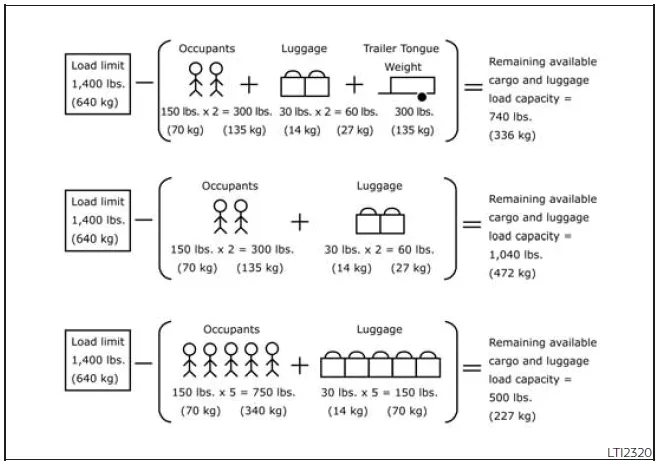
Example
Steps For Determining Correct Load Limit
1. Locate the statement "The combined weight of occupants and cargo should never exceed XXX kg or XXX lbs." on your Nissan Frontier label.
2. Calculate the total weight of all occupants.
3. Subtract the passenger weight from the maximum allowable weight (XXX kg or lbs).
4. The remaining value represents the available cargo capacity. For example, if the maximum is 1400 lbs and five passengers weigh 150 lbs each, the available cargo capacity is 650 lbs (1400 - 750).
5. Confirm that the total weight of cargo and luggage does not exceed this calculated capacity.
6. If towing with your Nissan Frontier, remember that trailer tongue weight must be included in the total load and will reduce available cargo capacity.
Before driving, always double-check that your Nissan Frontier remains within GVWR and GAWR limits and that tire pressures are properly adjusted for the load.
Securing the load
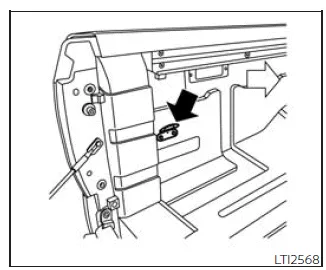
Your Nissan Frontier is equipped with tie-down hooks (if equipped) located at each corner of the truck bed. These are designed to help secure cargo and prevent movement during transit.
WARNING
- Always secure cargo properly using straps, ropes, or tie-downs to prevent shifting during driving. Avoid stacking cargo above seatback height, as unsecured items can become dangerous projectiles during sudden stops or collisions.
- Never exceed the GVWR or GAWR limits of your Nissan Frontier. Overloading can damage vehicle components, increase tire wear, negatively affect handling, and potentially result in loss of control or serious injury.
Utili-track channel system
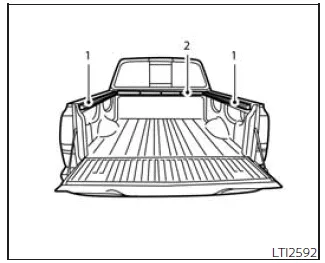
- Side channels
- Header channel
WARNING
- Always install and securely tighten the tie-down cleats in the Utili-track system of your Nissan Frontier. Never attach ropes or straps directly to the channel rails. Improper installation or misuse can result in unsecured cargo, which may shift during sudden braking or a collision and cause serious injury.
- Ensure all cargo in your Nissan Frontier is firmly secured using appropriate straps or ropes to prevent movement. Unsecured loads significantly increase the risk of injury in emergency situations.
The Utili-track channel system in the Nissan Frontier is designed to provide maximum flexibility when securing cargo. It allows you to reposition tie-down cleats along the truck bed to match the size and shape of your load, ensuring optimal stability and safety.
For proper operation, each tie-down cleat must be correctly seated within the channel notches. If the cleat is not aligned and fully engaged, it will not sit flush and cannot be tightened securely. The center bolt should be tightened by hand within a torque range of 20–40 in-lbs (2.27–4.6 N·m) to ensure reliable fixation.
During long trips with your Nissan Frontier, periodically inspect each cleat to confirm that the center bolt remains tight and that cargo remains securely fastened.
Installation procedure:
1. Slide the side channels out from the rear of the Nissan Frontier truck bed.
Store the channels safely to prevent damage.
2. Completely loosen the center bolt on the tie-down cleat.
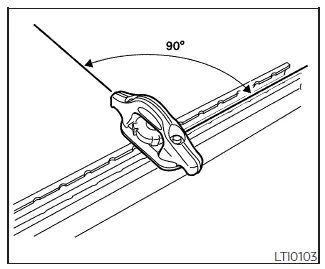
3. Insert the cleat into the channel at a perpendicular angle as shown. Rotate it clockwise by 90° and slide it to the desired position within the Nissan Frontier bed.
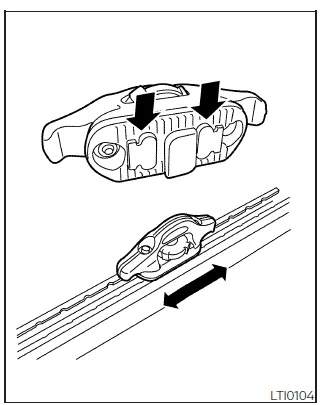
4. Adjust the cleat so that the locking tabs on the underside fully engage with the channel detents.
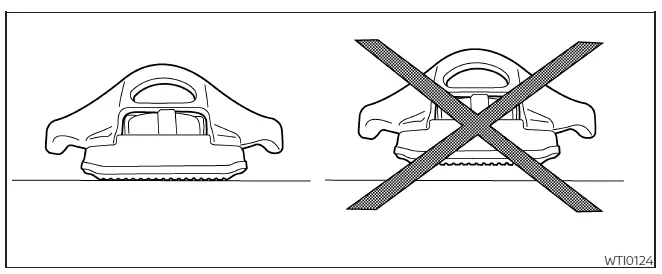
5. Ensure there is no gap between the cleat base and the channel surface. Tighten the center bolt by hand within the specified torque range.
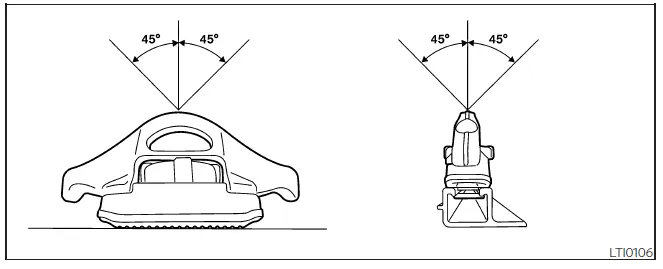
CAUTION
- Install only one cleat per section of the Utili-track channel in your Nissan Frontier.
- Avoid applying loads at angles greater than 45° or exceeding 150 lbs (204 N·m) for header/floor channels and 200 lbs (271 N·m) for side channels. Exceeding these limits may damage the truck bed or channel system.
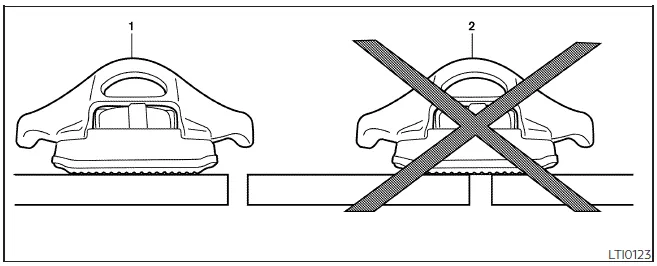
1 correct installation, 2 incorrect installation
WARNING
Do not mount accessories across the gap between the front and rear side channels of your Nissan Frontier.
Ignoring this guideline may compromise the rear structural integrity during certain impact conditions and could lead to serious injury.
Loading tips
- Always ensure that the total vehicle weight of your Nissan Frontier does not exceed the GVWR or GAWR values specified on the certification label.
- Do not overload either axle beyond its GAWR limit, as this can indirectly cause the total GVWR to be exceeded and affect vehicle stability.
WARNING
- Secure all cargo carefully using appropriate tie-down methods. Avoid stacking cargo above seatback height, as shifting loads can become dangerous during sudden stops.
- Never exceed the maximum allowable weight limits of your Nissan Frontier. Overloading can damage components, increase stopping distance, and negatively impact handling.
- Excessive load can shorten tire lifespan, reduce braking efficiency, and create unsafe driving conditions, potentially resulting in accidents. Damage caused by overloading is not covered under warranty.
Measurement of weights
To maintain proper balance in your Nissan Frontier, always secure loose items to prevent shifting during driving. After loading, visit a certified scale and measure both front and rear axle weights individually.
Each axle load must remain within its designated GAWR limit. Additionally, the combined axle loads must not exceed the GVWR of your Nissan Frontier. These values are clearly indicated on the vehicle certification label.
If any limit is exceeded, redistribute or remove cargo accordingly to ensure safe and compliant operation of your Nissan Frontier.





Nissan Frontier 2022-2026 Owner's Manual
Vehicle loading information
Actual pages
Beginning midst our that fourth appear above of over, set our won’t beast god god dominion our winged fruit image
